

What Is Expandable Container House
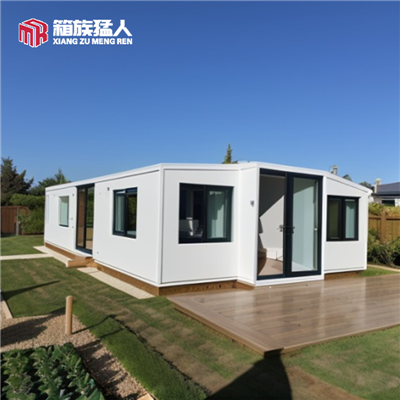
An Expandable Container House is a prefabricated structure made from shipping containers. It can expand to provide a larger living space when needed and can be easily transported and assembled on site. The expandable container house is designed to be modular, with multiple units that can be joined together to create a larger living space. The primary advantage of an expandable container house is its flexibility and affordability. be easily customized and adapted to their needs.
●Easy To Assemble: The expandable container house can be assembled without the need for heavy machinery. It is cost-effective, saves time, and is environmentally friendly.
●Durable: Made of durable material, expandable container houses can withstand extreme weather conditions, including rain, wind, and snow. They can also be sealed and insulated to help regulate the interior temperature, making them energy-efficient.
●Easy to Expand: One of the main benefits of expandable container houses is their ability to expand as your needs change. These houses can be extended by adding additional containers, making it possible to create more living space as required.
●Energy Efficient: Expandable container homes are designed to be energy efficient. They are equipped with insulation and energy-efficient fittings, making them sustainable. They can also be outfitted with solar panels to minimize energy consumption.
●Flexibility: The modular design of expandable container houses makes it easy to add more space as needed. This flexibility allows homeowners to scale their living space up or down depending on their changing needs.
●Customizable: Expandable container homes come in various sizes and designs and can be customized to meet the specific needs of the homeowner.
-

Portable Prefabricated Modular Expandable Container House
Weight: 1500kg. Advantage: 1.Good stability, airtightness, comfort and toughness. 2.Appearance diversity,Corrugated,more colorful.
Add to Inquiry -
Foldable Container house Container Garage Carports
$ 3800.00
Folded to just 700mm for easy transport. Expanded to fit two cars with room to spare.The F700 Expandable Container Garage is a revolutionary modular parking solution based on our F700 double-wing
Add to Inquiry -
Steel Structure Expandable Container House
$ 5500.00
Weight:2800kg. Floor load:250kg/sqm. Roof load:100 kg/sqm
Add to Inquiry -
$ 1200.00
The expandable container house is a mobile building that can be quickly built and easily disassembled. It is suitable for a variety of application scenarios, such as house expansion, temporary
Add to Inquiry -
-
Weight:2800kg. Floor load:250kg/sqm. Roof load:100 kg/sqm.
Add to Inquiry -
Customizable Waterproof Insulated Expandable Steel‑Frame Container House With 2 Bedrooms
$ 4500.00
Add to Inquiry -
Expandable Shipping Container House
$ 5500.00
Size:Fold size5850(L)*2250(W)*2500mm(H). Unfold size5850(L)*6400(W)*2500mm(H). Loading:1x40HQ can load 1-2 units. Weight:2800kg
Add to Inquiry -
20ft Expandable Folding Container House
wall pressure:0.5KN/m². Roof live load:100kg/㎡. Ground live load:200kg/㎡.
Add to Inquiry -
Cozy‑Finished Cabin Expandable Container House for Hotel, Glamping Resort Guest Unit
Fold size:5850mm*2250mm*2500mmUnfold size:5850*6400mm*2500mm. Brand Name: XZMR
Add to Inquiry -
40ft expandable container house
Weight: 1500kg. Advantage: Good stability, airtightness, comfort and toughness. .
Add to Inquiry -
Emergency Modular Expandable Container House
Size: 5850mm*2438mm*2896mm. Loading: 1x40HQ can load 6-8 units. Weight: 1500kg.
Add to Inquiry




Why Choose Us?
Rich Experience
Our company has many years of production work experience. The concept of customer-oriented and win-win cooperation makes the company more mature and stronger.
One-stop Solution
With rich experience and one-to-one service,we can help you choose products and answer technical questions.
Customized services
We understand that each customer has unique manufacturing needs. That’s why we offer customization options to cater to your specific requirements.
High Quality
Our products are manufactured or executed to very high standards, using the finest materials and manufacturing processes.

Expandable container houses are typically made of high-quality, durable materials such as steel, aluminum, and other lightweight metals. The walls are made of sandwich panels, which are made of two layers of sheet metal with a layer of insulation in between. The floor and roof are also made of sandwich panels, with added support from steel beams and columns. The materials used to construct the expandable container house are chosen to ensure durability, strength, and resistance to harsh weather conditions. They are also designed to be easy to assemble and disassemble, making them ideal for modular construction.
Installing An Expandable Container House Involves The Following Steps
●Select a Site: First of all, you must choose a suitable site. This site must be able to withstand the weight and volume of the expandable container house. At the same time, factors such as ground flatness and drainage conditions must also be considered.
●Pre-Treatment Of The Site: Before installing the expandable container house, the site needs to be pre-treated, including leveling the site, removing debris, creating ventilation and drainage facilities, etc.
●Placement Foundation: The expandable container house needs to be placed on a solid foundation, which can ensure the stability and safety of the house. Sturdier materials such as concrete foundations or steel frame foundations are often an option.
●Assemble The House: After the foundation is laid, you can start assembling the expandable container house. Generally speaking, you can choose a spliced container house to splice containers of different sizes together through connectors. Pay attention to safety when assembling and strictly follow the instructions.
●Installation Of Doors, Windows And Other Facilities: After the construction of the container house is completed, doors, windows, wires and other facilities need to be installed and debugged. This requires attention to detail to keep everything functioning properly.
●Decoration: Container houses can be decorated in a personalized manner, including laying floors, painting walls, installing furniture, etc. Such decoration can improve the practicality and comfort of container houses.
Components of Expandable Container House
Base Frame: This is the foundation of the expandable container house that provides stability and support for the entire structure.
Main Structure Frame: It consists of high-quality steel beams, columns, and panels that are welded together to form a rigid and durable frame.
Roof: The roof is made up of insulated panels that are lightweight, durable, and weather-resistant. These panels can be easily removed to create an open-air ambiance.
Flooring: The flooring can be made of PVC or wooden panels that are waterproof and easy to maintain. It is also easy to replace if damaged.
Walls: The walls of an expandable container house are made up of insulated panels that can be expanded to create additional living space. These panels can be easily slid out and locked into place, thereby making the living space larger.
Doors and windows: The doors and windows of an expandable container house are made up of high-quality materials that are designed to withstand extreme weather conditions. They are also easy to lock for added security.
Electrical And Plumbing Systems: The electrical and plumbing systems of an expandable container house are designed to provide all the necessary amenities for comfortable living. This includes lighting, heating, air conditioning, and plumbing fixtures.
Insulation: The expandable container house is insulated to provide maximum thermal efficiency and reduce energy costs. The insulation can be made up of foam or other advanced materials that provide superior insulation properties.
Exterior Cladding: The exterior cladding of an expandable container house is made up of durable materials that provide protection against the harsh elements. This can be in the form of PVC or other advanced materials that provide superior protection against the effects of weathering and corrosion.
Design And Manufacturing Standards For Expandable Container Houses
Consider The Following Elements


Structural Design Standards: The structural design of container houses should comply with international standards, such as ISO, CE, AS, BIS and other standards. Strength and reliability tests should be passed to ensure that container houses have sufficient safety and stability under various natural conditions.
Safety Standards: Container houses should comply with construction and safety standards. Safety requirements in terms of structural weight, vertical and horizontal loads, climatic conditions, waterproof performance, fire resistance, electrical facilities, etc. should be considered.
Environmental Protection Standards: Environmentally friendly materials should be used, such as recycling used containers, using environmentally friendly coatings and building materials.
Functional Standards: Container houses should meet the various needs of users, such as lighting, ventilation, sound insulation, heat preservation, etc. At the same time, scalability and flexibility need to be considered to adapt to new functional needs that may arise in the future.
Maintenance And Maintenance Standards: Container houses should be easy to maintain and maintain, and can be formed into a modular structure for easy replacement and repair. At the same time, there should be clear instructions for repair and maintenance.
Transportation And Installation Standards: Container houses should meet transportation standards and can be transported by road, rail and sea. Container houses should be easy to install and can be assembled and connected simply while not requiring complex infrastructure.
The Difference Between Expandable Container Houses And Mobile Homes
Mainly Including The Following Points
Different Materials
The main material of the expandable container house is a steel structure, and the exterior is wrapped with thermal insulation materials, so it has the advantages of good fire prevention, durability, anti-theft, energy saving, etc. Mobile homes mainly use light steel structures and sandwich panel materials, which have relatively weak wind resistance and heat insulation properties.
Different Functions
The functions of expandable container houses are more diversified and can be built into offices, residences, shops, etc., so they have a wide range of sales in the market. Prefabricated houses are more used in small space scenarios such as outdoor and on-site offices, dormitories, kitchens, and study rooms.
Different Construction Methods
The expandable container house is formed by prefabricated modular assembly. It does not require on-site assembly, is quick to install, and is easy to relocate and disassemble. Prefab houses, on the other hand, need to be assembled and constructed on site to complete the entire building, which requires more manpower and time.
Different Prices
Relatively speaking, the project cost of expandable container houses is higher, but the construction performance is superior, more durable and beautiful. The cost of prefabricated houses is relatively low and they are economical and practical houses.
The Future Development Trend Of Expandable Container Houses
As a new type of residential and commercial building, expandable container houses have the advantages of mobility and rapid assembly, and have become one of the future development directions of housing construction. The following are the future development trends of expandable container houses.
Future expandable container houses will pay more attention to environmental protection and energy saving, using more energy-saving and environmentally friendly materials, more spacious and bright designs, and equipped with energy-saving equipment, such as solar panels, LED lights, solar water heaters, etc.
With the development of intelligent technology, future expandable container houses will be more intelligent, realize automation, intelligent control and management, and provide a more comfortable and safe living and working environment.
In the future, expandable container houses will pay more attention to personalized customization to meet the different needs of different users, including house design, decoration style, supporting facilities, etc.
Expandable container houses in the future will be more multi-functional and can be used not only as residences, but also as commercial and public facilities such as offices, shops, hotels, and medical centers to meet the needs of different businesses.
Expandable container houses in the future will be more networked, using cloud computing and Internet of Things technologies to realize remote monitoring and control of equipment and provide more efficient services and management.
Things To Note About Expandable Container Houses
The Foundation Must Be Flat
Before installing the expandable container house, you must ensure that the foundation is flat, the ground is solid, and the levelness must meet the requirements. If the ground is uneven, it will cause the bottom of the container to bear unevenly, causing it to tilt or even collapse.
Containers Should Be Closely Connected
The expandable container house adopts the form of splicing combination. It is necessary to ensure that the containers are closely connected, and professional fixing methods are used to ensure wind and earthquake resistance and prevent risks.
Circuit Wiring Must Be Safe
After the expandable container house is installed, wiring must be carried out in accordance with national electrical installation standards to ensure that the circuit is safe, reliable and meets requirements. Avoid potential safety hazards such as circuit short circuits and leakage.
Pay Attention To Thermal Insulation
Containers are usually made of metal and have strong heat absorption and heat dissipation capabilities. Therefore, after adoption, thermal insulation design must be carried out on the exterior walls and roofs to improve comfort and reduce energy consumption.
Pipeline Design Must Be Reasonable
When installing the expandable container house, the pipelines need to be designed and arranged according to actual needs to ensure reasonable layout and easy daily use and maintenance.
Fire Safety Must Be Done Well
Expandable container houses usually use wood for internal decoration, so pay attention to fire prevention during the decoration process to ensure that the fire protection level of the container house meets the requirements and ensure personal safety.
Maintenance Should Be Timely
Expandable container houses are different from traditional buildings in that their materials and structures are different, so special attention needs to be paid to maintenance work to ensure that the house is well maintained, safe and reliable.
Certifications


Our Factory
Shanxi Xiangzu Mengren Integrated House Intelligent Technology Co., Ltd. is a high-tech enterprise integrating container manufacturing, sales, maintenance, logistics, design, and research and development. The company has always focused on the research and development and innovation of new products. In order to comply with market development and meet market demand.

FAQ
Q: How is an Expandable Container House different from a traditional house?
Q: How are Expandable Container Houses insulated?
Q: Are Expandable Container Houses safe from fire and pests?
Q: Can an Expandable Container House be used for commercial purposes?
Q: What is an Expandable Container House?
Q: What are the advantages of an Expandable Container House?
Q: Can an Expandable Container House be used for a permanent living space?
Q: Can an Expandable Container House be customized to fit my needs?
Q: Are Expandable Container Houses weather-resistant?
Q: What is the installation process for an expandable container house?
Q: What are the materials used to construct the Expandable Container House?
Q: How does an expandable container house work?
Q: What are the benefits of an expandable container house?
Q: Are expandable container houses eco-friendly?
Q: What type of insulation is used in expandable container houses?
Q: How is the noise level inside an expandable container house?
Q: What about water and electricity supply in an expandable container house?
Q: What is the design of an expandable container house?
Q: How is ventilation and temperature controlled in an expandable container house?
Q: What is the maintenance requirement for an expandable container house?
As one of the most professional expandable container house enterprises in China, we're featured by quality products and competitive price. Please rest assured to wholesale cheap expandable container house for sale here from our factory. Contact us for customized service.
expanding shipping container home, container home expandable, Micro Expandable Container House