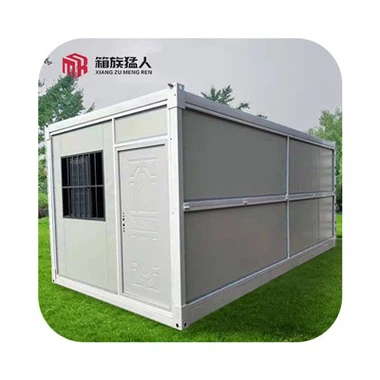
Container House Foreign Trade People: Seeking Opportunities in The Tariff Storm
Apr 12, 2025
Container house foreign trade people: Seeking opportunities in the tariff storm
On the chessboard of global trade, the container house industry is experiencing unprecedented challenges. Since Trump won the US presidential election in 2024, a series of tariff policies he has implemented after taking office, such as imposing high tariffs on goods from China and other countries, have plunged the container house foreign trade market into great uncertainty.
Container houses, a form of construction based on shipping containers, are widely popular around the world due to their low cost, convenient installation, and strong mobility, especially in some areas with large infrastructure construction needs and temporary living or office needs. However, today's tariff pressure is like a boulder, weighing heavily on the hearts of foreign trade practitioners.
Market shocks under the pressure of tariffs
As one of the world's important markets, the United States has considerable demand for container houses. However, the tariff policy of the Trump administration has put container house exports in major producing countries such as China in a difficult situation. According to relevant data, since the tariff increase, the number of container house orders exported from China to the United States has declined significantly. Chinese container houses, which originally had a price advantage, have seen a sharp rise in prices after adding high tariffs, and have lost their competitiveness in the US market. Many American customers have cancelled their orders and turned to other alternatives or import from other countries with lower tariffs.
This change has dealt a heavy blow to China's container house foreign trade enterprises. The sales of some enterprises have plummeted and their profit margins have been severely compressed. For example, a container house manufacturing company in Guangdong used to have 40% of its total export business in the US market, but after the tariff increase, the number of orders from the US fell by 60%, and the company had to face the dilemma of reducing production and laying off employees.
From the transportation level, the instability of the US tariff policy has also caused chaos in the container shipping market. Data released by the Shanghai Shipping Exchange showed that the Shanghai Export Container Comprehensive Freight Index fluctuated sharply, among which the market freight rates on the North American route continued to fall due to tariffs. The weak transportation demand has forced shipping companies to reduce their capacity, and some routes that originally traveled regularly between China and the United States have even stopped sailing. This not only increases the transportation costs of container house foreign trade enterprises, but also makes it difficult to guarantee the timeliness of cargo transportation, further affecting the cooperation between enterprises and customers.
Difficult choices for foreign traders
Faced with such a severe situation, container house foreign traders have begun to look for countermeasures. Some companies choose to turn their attention to other markets, such as Europe, the Middle East, and South America. The demand for container houses in these regions is also gradually increasing, and the tariff policy is relatively stable. For example, a container house company in Zhejiang has increased its efforts to develop the European market. By participating in local European construction industry exhibitions and cooperating with local dealers, it has successfully introduced its products to many European countries. In the past year, the company's exports to the European market have increased by 30%, which has made up for the losses in the US market to a certain extent.
Some companies have also tried to reduce costs by optimizing the supply chain to offset the impact of tariffs. They strengthened cooperation with raw material suppliers to strive for more favorable procurement prices; improved production efficiency and reduced waste in the production process; optimized logistics and distribution links to reduce transportation costs. A company in Jiangsu introduced an advanced production management system, shortening the production cycle by 20%. At the same time, by comparing prices with multiple logistics companies, it chose a more cost-effective logistics partner and successfully reduced the overall cost by 15%.
Re-export trade has also become an option for some companies to avoid high tariffs. Enterprises export container houses to third countries such as Southeast Asia, and then export them to the United States as third-country products after some processing or repackaging in the local area. However, this approach is not smooth sailing. Re-export trade not only involves complicated procedures and processes, but also involves certain risks. For example, goods may be delayed or damaged in the warehousing and container exchange in third countries, and once the US Customs finds that the goods are suspected of evading tariffs, they will face severe penalties. In addition, the cost of re-export trade is also high, including operating costs in third countries and fees for handling certificates of origin, which further compresses the profit margins of enterprises.
The road ahead is still long
Although container house foreign trade people actively respond to tariff pressure and strive to find a way out, the road ahead is still full of challenges. The uncertainty of the global trade environment still exists, and tariff policies may change at any time. In addition, with the intensification of market competition, enterprises not only have to face competition from their peers, but also have to deal with the impact of other alternative products.
However, challenges and opportunities coexist. With the continuous advancement of global infrastructure construction, the acceleration of urbanization and the increase in demand for environmentally friendly buildings, the container house market still has broad development prospects. For foreign traders in container houses, as long as they can continue to innovate, optimize the supply chain, and expand market channels, they may be able to find opportunities in the tariff storm and achieve sustainable development of their companies. In this era full of uncertainties, only reform and innovation are the only way to cope with challenges. The foreign trade industry of container houses will also usher in a new chapter of development in the baptism of wind and rain.